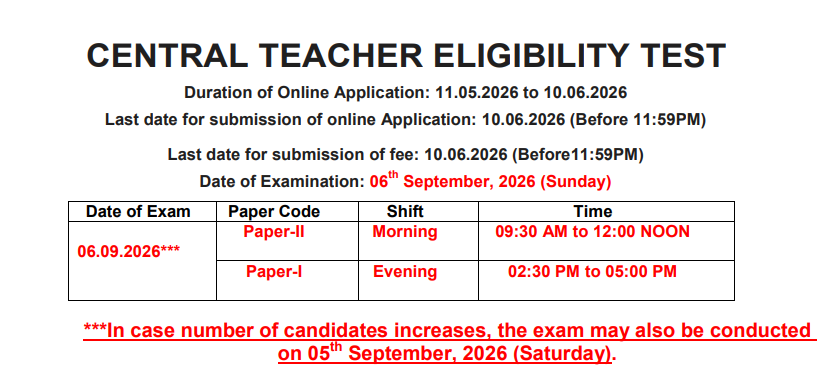
Central Board of Secondary Education (CBSE) has released CTET September 2026 (22nd Edition) notification. Online Application started 11 May 2026 and closes 10 June 2026 (11:59 PM) at ctet.nic.in. Exam Date: 06 September 2026 (Sunday).
Central Board of Secondary Education (CBSE)CTET September Syllabus Details 2026CTET Exam Details | Short Details of NotificationWWW.GOVFORMHUB.COM |
CTET Exam Pattern (September 2026)
| Paper | Level | Questions | Marks | Duration |
|---|---|---|---|---|
| Paper‑I | Class I–V (Primary) | 150 | 150 | 2 hours 30 minutes |
| Paper‑II | Class VI–VIII (Upper Primary) | 150 | 150 | 2 hours 30 minutes |
- Question Type: Objective MCQs (OMR‑based).
- Negative Marking: No negative marking (current pattern).
- Languages: English, Hindi, and 20+ regional languages.
CTET Paper‑I (Class I–V) – Syllabus
Total: 150 MCQs (150 marks, 2.5 hours)
1) Child Development and Pedagogy (30 Questions)
- Concept of development vs learning.
- Heredity vs environment, stages of development, Piaget, Kohlberg, Vygotsky, etc.
- Inclusive education, children with special needs, multilingual classroom, gender & socialization.
- Learning & pedagogy: basic processes, role of teacher, learning & thinking, assessment, problem‑solving.
2) Language‑I (Medium of Instruction – 30 Questions)
- Language comprehension (unseen prose & poetry).
- Pedagogy: learning & acquisition, listening/speaking, basic language skills, vocabulary & sentence structure, teaching‑learning materials, challenges in multilingual classrooms, remedial teaching.
3) Language‑II (Second Language – 30 Questions)
- Unseen comprehension (prose & poetry).
- Pedagogy similar to Language‑I (second‑language learning, classroom processes, materials, multilingual‑classroom issues).
4) Mathematics (30 Questions)
- Content (20 Questions):
- Number system (whole numbers, fractions, negatives, decimals), basic algebra, geometry (basic shapes), mensuration basics, data handling basics.
- Pedagogy (10 Questions):
- Nature of mathematics, place in curriculum, teaching methods, problem‑solving, mathematics as life‑skill, error‑analysis, remedial teaching.
5) Environmental Studies (EVS) (30 Questions)
- Content (20 Questions):
- Food, materials, living & non‑living things, plants, animals, human body, water, air, environment issues, space & technology, local environment, etc. (for Class III–V level).
- Pedagogy (10 Questions):
- Nature & aims of EVS, integration of subjects, experiential & activity‑based learning, experiments, field trips, evaluation, problems & remedies in EVS teaching.
CTET Paper‑II (Class VI–VIII) – Syllabus
Total: 150 MCQs (150 marks, 2.5 hours)
1) Child Development and Pedagogy (30 Questions)
- Same core child‑development concepts as Paper‑I (with more advanced theoretical understanding).
- Inclusive education, gifted & special‑need children, adolescence, motivation, learning & assessment at upper‑primary level.
2) Language‑I (Medium of Instruction – 30 Questions)
- Unseen comprehension (prose & poetry).
- Language pedagogy: learning & acquisition, role of listening/speaking, grammar perspectives, classroom process, evaluation, and challenges in teaching the subject.
3) Language‑II (Second Language – 30 Questions)
- Two unseen prose passages.
- Pedagogy of second‑language teaching (same as Language‑I but focused on second‑language acquisition).
4) Option‑1 – Mathematics & Science (60 Questions)
- Mathematics (30 Questions):
- Content (20): Integers, fractions, decimals, algebra (basic equations), geometry, mensuration, data handling.
- Pedagogy (10): Problem‑solving, place of mathematics in curriculum, remedial teaching, error‑analysis.
- Science (30 Questions):
- Content (20): Food, materials, living world, moving things, electricity, magnets, natural phenomena, resources, environment, etc.
- Pedagogy (10): Nature of science, methods & experiments, teaching of scientific concepts, evaluation, problem‑teaching.
5) Option‑2 – Social Science / Social Studies (60 Questions)
- Content (40 Questions):
- History, Geography, Social & Political Life (Indian history, freedom struggle, democracy, governance, social diversity, environment & resources, global issues).
- Pedagogy (20 Questions):
- Nature of Social Science/Social Studies, classroom processes, use of maps, projects, fieldwork, questioning, evaluation, and teaching‑learning strategies.
Preparation Tips
- Child Development & Pedagogy ko sabse pehle strong banao; is section se Paper‑I & Paper‑II dono me 30–30 marks aate hain.
- Paper‑I ke liye EVS & Maths aur Paper‑II ke liye apni stream (Maths & Science ya Social Science) par zyada focus rakho.
- Previous CTET papers (Paper‑I + Paper‑II) ko 2.5‑hour time‑bound test ke roop me daily solve karo taaki speed & accuracy improve ho.
Students Joined ! Free Updates For Recruitment / Syllabus / Admission / PYP – JOIN NOW
Important Links : CTET September Online Form 2026
| Apply Online | Click Here |
| Join GovFormhub Channel | Telegram | WhatsApp |
| Official Notification PDF | Download Now |
| Official Website | CTET |
FAQ (CTET September 2026)
| Question | Answer |
|---|---|
| What is CTET September 2026 syllabus? | Paper‑I: Child Development, Language‑I, Language‑II, Maths, EVS. Paper‑II: Child Development, Language‑I, Language‑II, plus Mathematics & Science or Social Science. |
| Is there negative marking? | No negative marking in CTET (current pattern). |
| How to apply online? | Apply via ctet.nic.in; register, fill form, upload documents, pay fee, and print confirmation. |
| When is the exam? | September 2026 (exact date in official notification). |
| What is the validity of CTET certificate? | Lifetime validity (no expiry period). |
Related Posts
RSSB Teaching Associate Syllabus 2026 Check Now
GNDU Non-Teaching Syllabus Details 2026 Check Now
UGC NET June Syllabus Details 2026 Check Now