
ISRO has released the notification for 92 Scientist/Engineer posts. The online application is open, and candidates can apply through the official ISRO careers portal.
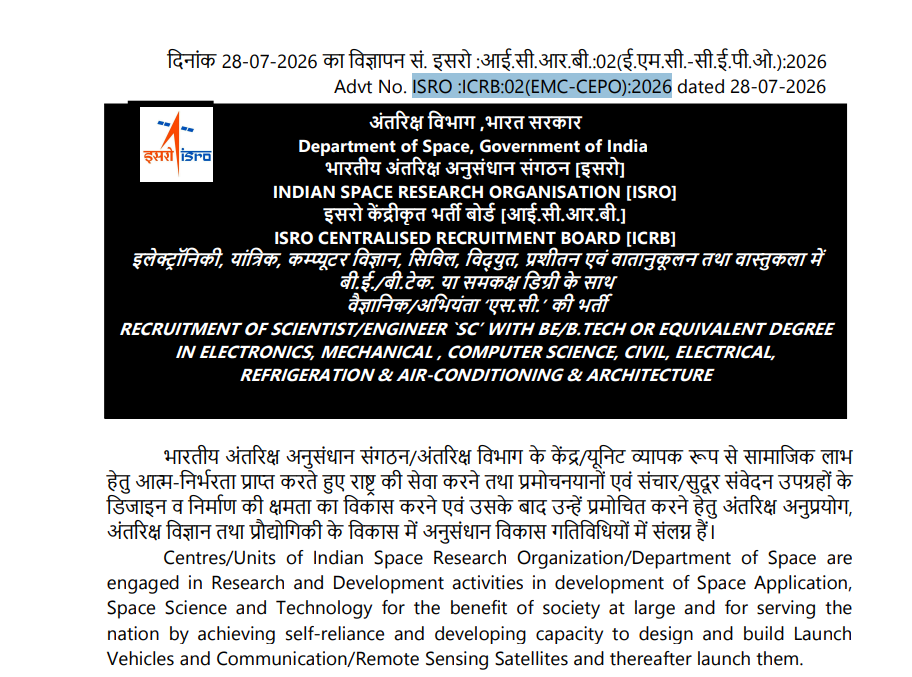
Indian Space Research Organisation (ISRO)ISRO Scientist/Engineer Syllbus Details 2026ADVT.NO.- ISRO :ICRB:02(EMC-CEPO):2026 | Short Details of NotificationWWW.GOVFORMHUB.COM |
Selection Pattern
A. GATE-Based Recruitment
| Stage | Details |
|---|---|
| Shortlisting | Valid GATE score के आधार पर |
| Interview | Technical interview |
| Final Merit | GATE score + Interview performance |
| Written Test | Not applicable for GATE-based vacancies |
B. Written Test-Based Recruitment
| Part | Subject | Questions | Marks |
|---|---|---|---|
| Part A | Discipline-Specific Technical | 80 | 80 |
| Part B | Aptitude / Ability Test | Up to 15 | 20 |
| Total | — | Up to 95 | 100 |
| Feature | Details |
|---|---|
| Duration | 120 minutes |
| Technical Questions | 80 MCQs |
| Technical Marking | +1 correct, -1/3 wrong |
| Aptitude Questions | Numerical, logical, diagrammatic, abstract and deductive reasoning |
| Aptitude Negative Marking | No negative marking |
कुछ M.E./M.Tech-based posts में descriptive technical section भी शामिल हो सकता है।
Aptitude / Ability Syllabus
| Topic | Key Areas |
|---|---|
| Numerical Reasoning | Number system, percentage, ratio, average, basic calculations |
| Logical Reasoning | Series, analogy, coding-decoding, arrangements |
| Diagrammatic Reasoning | Figures, patterns, visual relationships |
| Abstract Reasoning | Pattern recognition, symbols and shapes |
| Deductive Reasoning | Statements, conclusions, assumptions |
| Data Interpretation | Tables, graphs and charts |
| Basic Engineering Mathematics | Algebra, probability and basic statistics |
Technical Syllabus
Technical section candidate की engineering branch के अनुसार होता है।
A. Electronics & Communication Engineering
| Topic | Key Areas |
|---|---|
| Network Theory | Circuit laws, network theorems, AC/DC circuits |
| Electronic Devices | Diodes, transistors, FET, semiconductor devices |
| Analog Circuits | Amplifiers, oscillators, feedback, op-amps |
| Digital Electronics | Logic gates, Boolean algebra, flip-flops, counters |
| Signals & Systems | Continuous/discrete signals, Fourier and Laplace concepts |
| Communication Systems | Modulation, demodulation, noise, antennas |
| Control Systems | Feedback, stability, time and frequency response |
| Electromagnetics | Fields, waves, transmission lines, waveguides |
| Microwave Engineering | Microwave devices and systems |
| VLSI & Embedded Systems | Digital design, microprocessors, microcontrollers |
B. Mechanical Engineering
| Topic | Key Areas |
|---|---|
| Engineering Mechanics | Force, friction, work, energy and equilibrium |
| Strength of Materials | Stress, strain, bending, shear and torsion |
| Theory of Machines | Mechanisms, gears, vibration and balancing |
| Machine Design | Shafts, bearings, gears, couplings and joints |
| Thermodynamics | Laws, cycles, entropy and properties of steam |
| Fluid Mechanics | Fluid flow, pumps, turbines and hydraulic machines |
| Heat Transfer | Conduction, convection and radiation |
| Manufacturing | Casting, welding, machining and forming |
| IC Engines | Engine cycles, combustion and performance |
| Industrial Engineering | Production, quality control and maintenance |
| Refrigeration & AC | Refrigeration cycles and air-conditioning basics |
C. Computer Science & Information Technology
| Topic | Key Areas |
|---|---|
| Programming | C/C++, algorithms and programming concepts |
| Data Structures | Arrays, stacks, queues, linked lists, trees, graphs |
| Algorithms | Searching, sorting, complexity and graph algorithms |
| Digital Logic | Boolean algebra, logic gates, combinational and sequential circuits |
| Computer Organisation | CPU, memory, instruction and I/O systems |
| Operating Systems | Processes, threads, scheduling, memory and file systems |
| DBMS | SQL, normalization, transactions and database design |
| Computer Networks | OSI/TCP-IP, routing, protocols and network security |
| Theory of Computation | Automata, grammars and computability |
| Compiler Design | Lexical analysis, parsing and code generation |
| Software Engineering | SDLC, testing and software design |
D. Electrical Engineering
| Topic | Key Areas |
|---|---|
| Electrical Circuits | Network laws, theorems, AC/DC analysis |
| Electrical Machines | Transformers, motors and generators |
| Power Systems | Generation, transmission, distribution and protection |
| Power Electronics | Converters, inverters, rectifiers and thyristors |
| Control Systems | Feedback, stability and system response |
| Electrical Measurements | Instruments, errors and measurement systems |
| Signals & Systems | Continuous/discrete systems and transforms |
| Analog & Digital Electronics | Circuits, logic and semiconductor devices |
| Electromagnetic Theory | Fields, waves and transmission lines |
| Engineering Mathematics | Calculus, differential equations, probability and statistics |
E. Civil Engineering
| Topic | Key Areas |
|---|---|
| Engineering Mechanics | Force systems, equilibrium and friction |
| Strength of Materials | Stress, strain, bending and torsion |
| Structural Analysis | Beams, trusses and frames |
| RCC & Steel Design | Beams, slabs, columns and foundations |
| Geotechnical Engineering | Soil properties, bearing capacity and consolidation |
| Fluid Mechanics | Fluid properties, flow and hydraulic machines |
| Hydrology & Water Resources | Rainfall, runoff, irrigation and groundwater |
| Environmental Engineering | Water supply, sewage and pollution control |
| Transportation Engineering | Roads, pavements, traffic and railways |
| Surveying & Geomatics | Levelling, theodolite, GPS and total station |
| Construction Management | Estimation, costing, planning and quality control |
F. Chemical Engineering
| Topic | Key Areas |
|---|---|
| Process Calculations | Material and energy balances |
| Chemical Thermodynamics | Laws, phase equilibrium and properties |
| Fluid Mechanics | Fluid flow, pumps and compressors |
| Heat Transfer | Heat exchangers, conduction and convection |
| Mass Transfer | Distillation, absorption and extraction |
| Reaction Engineering | Reaction kinetics and reactor design |
| Process Control | Controllers, instrumentation and dynamics |
| Mechanical Operations | Size reduction, filtration and mixing |
| Chemical Technology | Industrial chemical processes |
| Process Safety | Hazard analysis, safety and pollution control |
G. Physics / Mathematics / Related Science Posts
| Discipline | Key Areas |
|---|---|
| Physics | Classical mechanics, quantum mechanics, electromagnetism, optics, solid state physics |
| Mathematics | Algebra, calculus, differential equations, numerical methods, probability and statistics |
| Chemistry | Physical, organic, inorganic and analytical chemistry |
| Space Science | Satellite systems, remote sensing, astronomy and space technology basics |
Interview Preparation
| Area | What to Prepare |
|---|---|
| Technical Knowledge | Core subjects from graduation/postgraduation |
| Project Work | Final-year project, research and practical applications |
| Space Technology | ISRO missions, satellites, launch vehicles and applications |
| Current Affairs | Recent space, science and technology developments |
| Communication | Clear explanation of technical concepts |
| Problem Solving | Practical engineering and research-based situations |
Quick Preparation Focus
- अपनी branch के GATE-level core subjects को सबसे पहले revise करो।
- Technical MCQs में accuracy बढ़ाने के लिए previous papers और mock tests लगाओ।
- Aptitude section में numerical, logical और diagrammatic reasoning पर focus रखो।
- ISRO missions, launch vehicles, satellites और current space developments की basic जानकारी रखो।
- अगर vacancy GATE-based है, तो interview में अपने project और core technical concepts की तैयारी सबसे जरूरी है।
Important Links : ISRO Scientist/Engineer Recruitment 2026
| Apply Online | Click Here |
| Join GovFormhub Channel | Telegram | WhatsApp |
| Official Notification PDF | Download Now |
| Official Website | ISRO |
Students Joined ! Free Updates For Recruitment / Syllabus / Admission / PYP – JOIN NOW
Short FAQ
| Item | Details |
|---|---|
| Exam Name | ISRO Scientist/Engineer Recruitment 2026 |
| Organisation | Indian Space Research Organisation (ISRO) |
| Post | Scientist/Engineer ‘SC’ |
| Recruitment Routes | GATE Score or Written Test, depending on vacancy/advertisement |
| Main Disciplines | Electronics, Mechanical, Computer Science, Electrical, Civil and other notified branches |
| Selection Process | GATE Shortlisting / Written Test, Interview, Document Verification, Medical Examination |
| Job Level | Group ‘A’, Level 10 |
Related Posts
Delhi Cantonment Board Syllabus Details 2026 Check Now
AVNL Technician & Executive Syllabus 2026 Check Now
BPCL Non-Management Syllabus Details 2026 Check Now